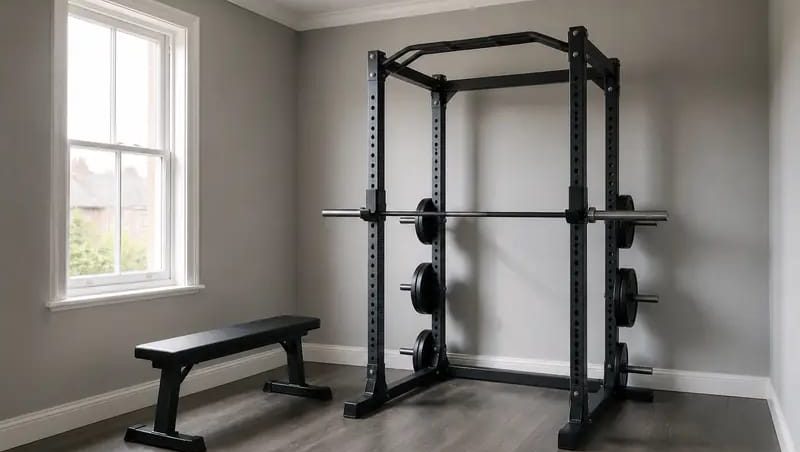
A gym rack may look simple when it is displayed in a shop or on a web site but actually requires a lot of space. So it is very important to check the measurements before you buy to make sure that the rack will fit in the space you have. Also, consider the route the rack will have to take through any hallways and the size of the stairwell.
The Rack’s Actual Footprint
A typical gym rack will have a base to the uprights of approximately 1.2m/1.5m wide and 1.1m/1.3m deep. On top of this you must allow for the overhang of the pull up bar which can extend beyond the uprights themselves. For this reason it is worth considering the home rack as part of the general guidance on resistance training for staying active, and looking at the minimum room sizes for new UK homes to get an idea of how much space a small bedroom or box room actually is once you have allowed for a rack, bench and space to move around in.
Headroom For The Pull-Up Bar
The height of your ceiling is not the same as your standing height. The height of the pull-up bar must also be taken into account. So the height of any fixtures such as lights, storage or even beams will need to be subtracted from your ceiling height. This will give you a much more realistic view of the height of the rack and whether it will fit.
Loading Space At Each End
This is the width you need to allow for the space that the plates will take when hung off the end of the bar. This needs to be clear of any wall, or shelf, and allow for the plates to hang flat, and for you to add and remove the weights without them dropping to the floor and hitting each other. This is often the worst measurement for a narrow garage, and can surprise people who think that as long as the rack fits, the bar will fit.
Room To Step Back
The various lifts you can perform using a gym rack include squats, rack pulls, and bench presses. So in order to perform these exercises safely you need to be able to step back from the hooks of the rack. Therefore, a minimum of 1m of floor space is required behind the uprights of a rack. Additionally, you would also need space in front of the rack to lie on a flat bench, or to perform barbell lifts. The public guidance on guidance on physical activity for health goes into more detail. For Gym Racks, see https://uk.repfitness.com/collections/gym-racks/.
A Fall Zone Around The Rack
Human error does exist, especially when people are in the middle of a grueling workout. In order to accommodate for any possible human error, it is recommended to have a clear strip of floor space around the base of the rack. This fall zone can be used to store other gym accessories and weights, and can also provide enough room for any mirrors or other gym equipment. Clearance of floor space around the base of the rack for any obstructions such as other gym equipment, or even gym accessories such as dumbbells, is crucial.
Keeping Attachments Nearby
Additionally, you will need somewhere to store plates, spare bars, dip attachments and safety spotter arms. The easiest way to store this is on a wall mounted plate tree or on a simple shelf to one side of the rack. The dimensions of a gym rack can vary depending on the gym rack model, gym rack attachments and even the type of Gym Rack post used. For this reason we have laid out our entire gym racks collection and have compared the footprints and Gym Rack attachments of each to help you compare before you buy.
Doorways, Halls And Stairs
Consider the space through which your gym equipment will travel when buying. Doorways, hallways and staircases all need to be wide enough for the rack to pass through. Measure the width of all these spaces and compare to the flat packed frame of the gym rack as this is usually how they are delivered in separate parts for the uprights and cross members. Some gym racks are delivered partly welded or even in a boxed configuration and it is essential to check the overall dimensions of the packaged item to ensure that it will fit through the narrowest part of any doorway.
Mark It Out Before You Buy
Simply tape out a rectangle on your floor to the width and depth of the proposed gym rack plus the space needed for loading and the fall zone. Then walk inside the taped area and stand with your back to the ‘rack’ reach up to the pull-up bar, step back from the barbell hooks and mimic a few reps of bench press etc. If you feel too cramped then you’ll certainly feel this when actually lifting weights in the room.
Measuring twice with a tape measure costs nothing. Having a gym rack that does not fit the room you bought it for for is much more expensive!
